

Can a Non Detachable Spiral Plate Heat Exchanger be used for gas - to - gas heat exchange?
As a supplier of non-detachable spiral plate heat exchangers, I often encounter questions from clients about the applicability of our products in various heat exchange scenarios. One common query is whether a non-detachable spiral plate heat exchanger can be used for gas-to-gas heat exchange. In this blog post, I will explore this topic in detail, considering the design features, advantages, limitations, and practical applications of non-detachable spiral plate heat exchangers in gas-to-gas heat exchange.
Design Features of Non Detachable Spiral Plate Heat Exchangers
Non-detachable spiral plate heat exchangers consist of two long metal plates wound around a central core to form two concentric spiral channels. The plates are welded at the edges to create a sealed structure, which prevents the mixing of the two fluids flowing through the channels. This design provides a large heat transfer area in a compact space, allowing for efficient heat exchange between the two fluids.
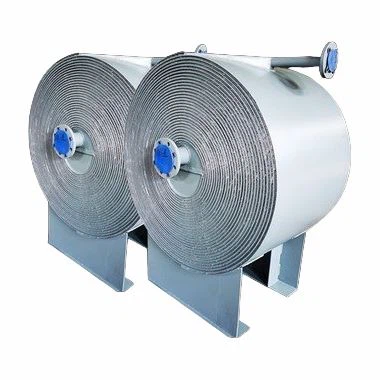

The spiral flow pattern of the fluids in the heat exchanger enhances the heat transfer coefficient by promoting turbulence and reducing the boundary layer thickness. Additionally, the counter-current flow arrangement of the two fluids maximizes the temperature difference between them, further improving the heat transfer efficiency.
Advantages of Using Non Detachable Spiral Plate Heat Exchangers for Gas - to - Gas Heat Exchange
- High Heat Transfer Efficiency: The large heat transfer area and the spiral flow pattern of the fluids in non-detachable spiral plate heat exchangers result in high heat transfer coefficients, making them suitable for gas-to-gas heat exchange applications. The counter-current flow arrangement also ensures that the temperature difference between the hot and cold gases is maintained throughout the heat exchanger, maximizing the heat transfer rate.
- Compact Design: Non-detachable spiral plate heat exchangers have a compact design, which makes them ideal for applications where space is limited. They can be easily installed in existing systems without requiring significant modifications.
- Low Pressure Drop: The smooth spiral channels in non-detachable spiral plate heat exchangers result in low pressure drops for both the hot and cold gases. This reduces the energy consumption required to pump the gases through the heat exchanger, making it a cost-effective solution for gas-to-gas heat exchange.
- Corrosion Resistance: Non-detachable spiral plate heat exchangers can be made from a variety of materials, including carbon steel, stainless steel, and titanium. Depending on the application requirements, the appropriate material can be selected to ensure corrosion resistance and long service life. For example, Carbon Steel Spiral Plate Heat Exchanger is a cost-effective option for general applications, while Titanium Spiral Plate Heat Exchanger is suitable for applications where high corrosion resistance is required.
Limitations of Using Non Detachable Spiral Plate Heat Exchangers for Gas - to - Gas Heat Exchange
- Difficulty in Cleaning: Since non-detachable spiral plate heat exchangers have a sealed structure, it can be difficult to clean the internal channels. This can be a problem if the gases contain particulate matter or contaminants that can accumulate on the heat transfer surfaces, reducing the heat transfer efficiency over time.
- Limited Operating Pressure and Temperature: Non-detachable spiral plate heat exchangers are typically designed for relatively low operating pressures and temperatures. If the application requires high-pressure or high-temperature operation, alternative heat exchanger designs may be more suitable.
- Single Pass Design: Non-detachable spiral plate heat exchangers usually have a single pass design, which means that the gases flow through the heat exchanger only once. This may not be sufficient for applications where a high degree of heat transfer is required, and multiple passes or a different heat exchanger design may be necessary.
Practical Applications of Non Detachable Spiral Plate Heat Exchangers in Gas - to - Gas Heat Exchange
- Industrial Heating and Cooling Systems: Non-detachable spiral plate heat exchangers can be used in industrial heating and cooling systems to recover waste heat from exhaust gases and transfer it to incoming fresh air or process gases. This helps to reduce energy consumption and improve the overall efficiency of the system.
- HVAC Systems: In HVAC systems, non-detachable spiral plate heat exchangers can be used for heat recovery from exhaust air and preheating of incoming fresh air. This can significantly reduce the energy required to heat or cool the building, resulting in cost savings and environmental benefits.
- Chemical Processing: Non-detachable spiral plate heat exchangers are commonly used in chemical processing plants for heat exchange between different process gases. They can be used to cool hot gases before further processing or to heat cold gases to the required temperature for a chemical reaction.
Considerations for Using Non Detachable Spiral Plate Heat Exchangers in Gas - to - Gas Heat Exchange
- Gas Properties: The properties of the gases, such as their viscosity, thermal conductivity, and specific heat capacity, can have a significant impact on the heat transfer performance of the non-detachable spiral plate heat exchanger. It is important to consider these properties when selecting the appropriate heat exchanger design and operating conditions.
- Contaminant Removal: To prevent fouling of the heat transfer surfaces, it is necessary to remove any particulate matter or contaminants from the gases before they enter the heat exchanger. This can be achieved through the use of filters or other gas cleaning equipment.
- System Integration: Non-detachable spiral plate heat exchangers need to be integrated into the overall gas handling system carefully. This includes considering the flow rates, pressures, and temperatures of the gases, as well as the piping and valve arrangements.
Conclusion
In conclusion, non-detachable spiral plate heat exchangers can be used for gas-to-gas heat exchange applications, offering high heat transfer efficiency, compact design, low pressure drop, and corrosion resistance. However, they also have some limitations, such as difficulty in cleaning, limited operating pressure and temperature, and a single pass design. When considering the use of non-detachable spiral plate heat exchangers for gas-to-gas heat exchange, it is important to carefully evaluate the specific application requirements and consider the advantages and limitations of this heat exchanger design.
If you are interested in using non-detachable spiral plate heat exchangers for your gas-to-gas heat exchange application, Horizontal Spiral Plate Heat Exchanger is one of our popular products that you may want to consider. Our team of experts can provide you with detailed technical information and help you select the most suitable heat exchanger for your needs. We welcome you to contact us for further discussion and to start the procurement process.
References
- Incropera, F. P., & DeWitt, D. P. (2002). Fundamentals of Heat and Mass Transfer. John Wiley & Sons.
- Shah, R. K., & Sekulic, D. P. (2003). Fundamentals of Heat Exchanger Design. John Wiley & Sons.
- Kakac, S., & Liu, H. (2002). Heat Exchangers: Selection, Rating, and Thermal Design. CRC Press.