

Hey there! I'm a supplier of Through Flow Spiral Plate Heat Exchangers, and I'm stoked to share with you all the rad advantages of a counter - flow arrangement in these bad boys.
Let's start with the basics. A through - flow spiral plate heat exchanger is a pretty cool piece of equipment. It consists of two long, flat plates that are coiled together to form a spiral shape. The two fluids flow through the channels created by these coiled plates, and heat is transferred between them. Now, when we talk about the flow arrangement, there are two main types: parallel - flow and counter - flow. But in my opinion, the counter - flow arrangement is where it's at.
First off, let's talk about temperature efficiency. In a counter - flow through - flow spiral plate heat exchanger, the two fluids flow in opposite directions. This means that the hot fluid enters at one end and the cold fluid enters at the other. As they move along the channels, the temperature difference between the two fluids remains relatively constant across the length of the heat exchanger.
Think about it this way. When you try to get the most heat transfer out of a system, you want to keep that temperature difference as large as possible. In a parallel - flow arrangement, the hot and cold fluids start off with a big temperature difference at the inlet, but as they flow along, this difference decreases. So, the rate of heat transfer slows down.
In a counter - flow setup, though, we can achieve a much higher heat transfer rate. The hot fluid is always in contact with a cooler part of the cold fluid as it moves through the exchanger. This allows for a more efficient transfer of heat, and we can get the cold fluid up to a higher temperature and the hot fluid down to a lower temperature compared to a parallel - flow arrangement.
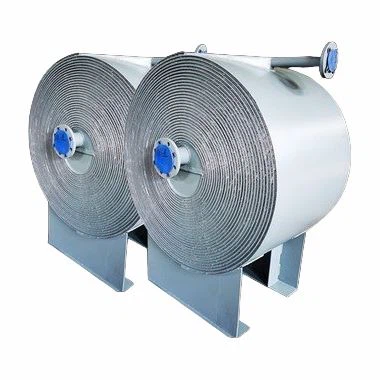

Another major advantage is the effectiveness in heat transfer. The effectiveness of a heat exchanger is a measure of how well it can transfer heat from one fluid to the other. In a counter - flow through - flow spiral plate heat exchanger, the effectiveness can be really high.
Let's say you're using this heat exchanger in an industrial process where you need to heat up a cold fluid using a hot one. With a counter - flow arrangement, you can get a lot more heat into the cold fluid with less surface area. This means you can use a smaller heat exchanger, which saves on space and cost.
For example, if you're running a chemical plant and you need to heat up a large volume of a cold reactant using a hot waste stream, a counter - flow through - flow spiral plate heat exchanger can do the job more effectively. You won't need a huge, bulky heat exchanger taking up a ton of floor space.
Now, let's touch on the flexibility of operation. Counter - flow through - flow spiral plate heat exchangers are super flexible when it comes to different flow rates and temperature requirements. You can adjust the flow rates of the hot and cold fluids independently, and the heat exchanger will still perform well.
Let's say your production process has some fluctuations in the flow rate of the hot fluid. With a counter - flow arrangement, the heat exchanger can adapt to these changes without a significant drop in performance. The constant temperature difference across the exchanger helps to maintain a stable heat transfer rate, even when the flow rates change.
This flexibility is really crucial in industries where the operating conditions can vary. For instance, in a food processing plant, the flow rate of the hot steam used for pasteurization might change depending on the production volume. A counter - flow through - flow spiral plate heat exchanger can handle these variations and keep the process running smoothly.
What about fouling? Fouling is a big problem in heat exchangers. It's when deposits build up on the heat transfer surfaces, which reduces the heat transfer efficiency. In a counter - flow through - flow spiral plate heat exchanger, the flow pattern helps to reduce fouling.
The high - velocity flow in the spiral channels created by the counter - flow arrangement can help to dislodge any potential deposits. The turbulent flow also prevents the accumulation of particles on the heat transfer surfaces. This means less downtime for cleaning and maintenance, which is a huge plus for any industrial operation.
Now, I want to mention some of the different types of spiral plate heat exchangers we offer. If you're interested in a more flexible option, you might want to check out our Dismountable Spiral Plate Heat Exchanger. It allows for easy cleaning and maintenance, which is great if you're dealing with fluids that are prone to fouling.
For those who need a heat exchanger that can withstand harsh conditions, our Carbon Steel Spiral Plate Heat Exchanger is a solid choice. Carbon steel is strong and durable, making it suitable for a wide range of industrial applications.
And if you're looking for something a bit more specialized, we also have the Bubble Spiral Plate Heat Exchanger. This type is designed to handle two - phase flow and can be really useful in certain chemical and petrochemical processes.
In summary, a counter - flow arrangement in a through - flow spiral plate heat exchanger offers a whole bunch of advantages. It provides better temperature efficiency, higher heat transfer effectiveness, flexibility in operation, and reduced fouling. These benefits make it a top choice for a wide range of industrial applications.
If you're in the market for a through - flow spiral plate heat exchanger, or you just want to learn more about how these things work, don't hesitate to reach out. We're here to help you find the perfect heat exchanger for your needs. Whether it's for a small - scale operation or a large - scale industrial plant, we've got the expertise and the products to make it happen.
Let's start a conversation and see how we can improve your heat transfer process. We look forward to talking with you and helping you get the most out of your heat exchanger.
References
- Incropera, F. P., & DeWitt, D. P. (2002). Introduction to Heat Transfer. John Wiley & Sons.
- Shah, R. K., & Sekulic, D. P. (2003). Fundamentals of Heat Exchanger Design. Wiley - Interscience.