

Hey there! As a supplier of Vertical Spiral Plate Heat Exchangers, I've seen firsthand how crucial the temperature difference between two fluids is in heat transfer. Let's dive into how this temperature difference impacts the performance of these heat exchangers.
Understanding the Basics of Heat Transfer in Vertical Spiral Plate Heat Exchangers
First off, a Vertical Spiral Plate Heat Exchanger is a nifty piece of equipment. It consists of two long metal plates that are coiled around a central core, creating two separate channels for the hot and cold fluids to flow through. The heat transfer happens as the two fluids flow in opposite directions, allowing for efficient heat exchange.
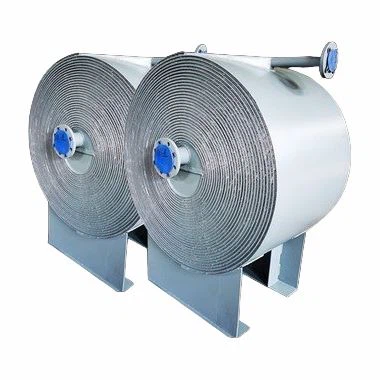

The fundamental principle behind heat transfer is pretty straightforward. Heat always flows from a hotter object to a colder one. In the case of our heat exchanger, the hot fluid transfers its thermal energy to the cold fluid through the metal plates. The rate at which this heat transfer occurs is influenced by several factors, and the temperature difference between the two fluids is one of the most significant ones.
The Role of Temperature Difference in Heat Transfer
So, how exactly does the temperature difference affect heat transfer? Well, it's all about the driving force. The greater the temperature difference between the hot and cold fluids, the higher the driving force for heat transfer. Think of it like a waterfall. The bigger the height difference between the top and bottom of the waterfall, the more force the water has as it rushes down. Similarly, a larger temperature difference means more energy is available to be transferred from the hot fluid to the cold fluid.
When the temperature difference is large, the heat transfer rate is high. This means that more heat can be transferred in a given amount of time. In practical terms, this translates to a more efficient heat exchanger. For example, if you're using a Vertical Spiral Plate Heat Exchanger to heat up a cold fluid using a hot fluid, a larger temperature difference will allow you to heat the cold fluid more quickly.
On the other hand, when the temperature difference is small, the driving force for heat transfer is reduced. This results in a lower heat transfer rate. It might take longer to achieve the desired temperature change in the cold fluid, or you might need to increase the flow rate of the fluids to compensate for the lower heat transfer rate.
Impact on Heat Exchanger Design and Performance
The temperature difference between the two fluids also has a significant impact on the design and performance of the Vertical Spiral Plate Heat Exchanger. When designing a heat exchanger, engineers need to consider the expected temperature difference between the hot and cold fluids. This helps them determine the size and configuration of the heat exchanger to ensure optimal performance.
For instance, if the temperature difference is large, the heat exchanger might need to be designed with a larger surface area to facilitate the high rate of heat transfer. This could mean using more plates or increasing the length of the plates. On the other hand, if the temperature difference is small, a smaller heat exchanger might be sufficient.
The performance of the heat exchanger can also be affected by the temperature difference. If the temperature difference is too large, it can lead to issues such as thermal stress on the plates. This can cause the plates to warp or crack over time, reducing the efficiency and lifespan of the heat exchanger. On the other hand, if the temperature difference is too small, the heat exchanger might not be able to transfer enough heat to meet the requirements of the application.
Real-World Applications and Considerations
In real-world applications, the temperature difference between the two fluids can vary depending on the specific process. For example, in a chemical plant, the hot fluid might be a high-temperature process stream, while the cold fluid could be cooling water. The temperature difference between these two fluids can be quite large, which requires a heat exchanger that can handle the high heat transfer rate.
On the other hand, in a food processing application, the temperature difference might be relatively small. For example, you might be using a heat exchanger to heat up a food product from room temperature to a slightly higher temperature. In this case, a smaller heat exchanger with a lower heat transfer rate might be sufficient.
It's also important to consider the cost and energy efficiency when dealing with different temperature differences. A larger temperature difference generally means higher heat transfer rates, but it might also require more energy to maintain the temperature difference. This can increase the operating costs of the heat exchanger. On the other hand, a smaller temperature difference might result in lower heat transfer rates, but it could also be more energy-efficient.
Our Product Offerings
At our company, we offer a range of Vertical Spiral Plate Heat Exchangers to meet different temperature difference requirements. We have 304 Stainless Steel Spiral Plate Heat Exchanger, which is suitable for applications where corrosion resistance is important. Our 316L Stainless Steel Spiral Plate Heat Exchanger offers even higher corrosion resistance, making it ideal for more demanding environments. And for applications where cost is a major factor, we have the Carbon Steel Spiral Plate Heat Exchanger.
Conclusion and Call to Action
In conclusion, the temperature difference between the two fluids plays a crucial role in the heat transfer process of a Vertical Spiral Plate Heat Exchanger. It affects the heat transfer rate, the design and performance of the heat exchanger, and the overall cost and energy efficiency of the system.
If you're in the market for a Vertical Spiral Plate Heat Exchanger, we'd love to have a chat with you. Whether you're dealing with a large or small temperature difference, we can help you find the right heat exchanger for your application. Just reach out to us, and we'll work with you to understand your needs and provide you with the best solution.
References
- Incropera, F. P., DeWitt, D. P., Bergman, T. L., & Lavine, A. S. (2019). Fundamentals of Heat and Mass Transfer. Wiley.
- Shah, R. K., & Sekulic, D. P. (2003). Fundamentals of Heat Exchanger Design. Wiley.